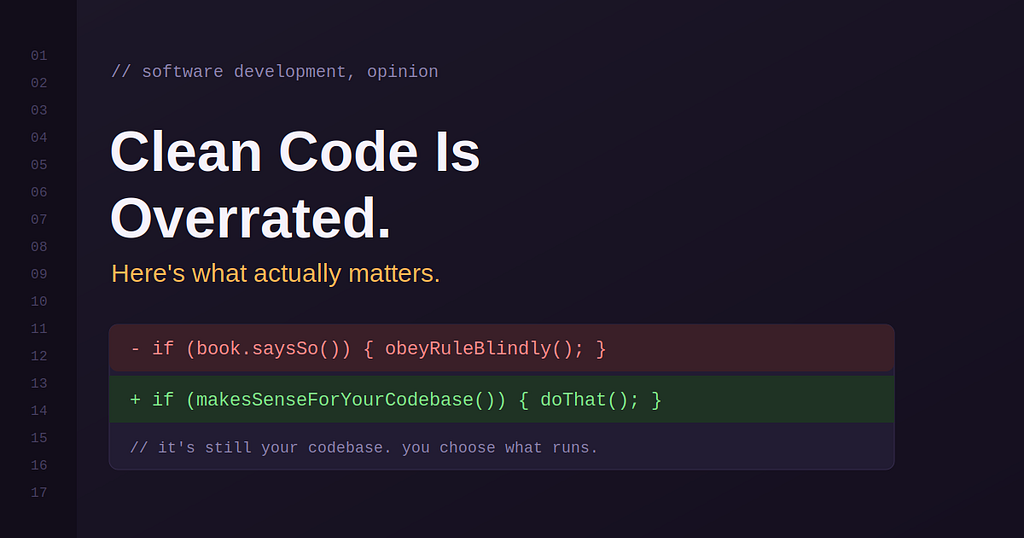
Reading the book is good. Treating it as law is where teams go wrong.
Section 1: The Cult of Clean Code
There’s a special kind of pain reserved for developers who just discovered the “Clean Code” philosophy.
You know the phase. You rename every variable to something that reads like a sentence. You break a 10-line function into six 2-line functions with names like validateAndPrepareUserInputBeforeProcessing(). You refuse to write an "if" statement without extracting it into its own method, "for readability."
Six months later, you open that same file and need three monitors and a family therapist to figure out what it does.
Clean code didn’t save you. It just moved the mess somewhere harder to find.
I’ve been that developer. Maybe you have too. Let’s talk about it.
Somewhere along the way, “Clean Code” stopped being advice and became a religion. And like most religions, it comes with commandments nobody’s allowed to question:
- Functions should be tiny. Ideally one line. Maybe zero.
- Comments are a confession of failure.
- Every class needs exactly one reason to change (nobody has ever agreed on what that reason actually is).
- If a class has only one implementation, it still deserves an interface. Just in case. Someday. Maybe.
None of this is wrong. It’s just incomplete. It treats code like a term paper being graded for elegance, and forgets that code’s real job is simple: solve the problem, ship it, and survive contact with a tired human at 4:58pm on a Friday.
Rules don’t ship features. People do.
Section 2: A Painfully Relatable Example
Say you need to check if a user qualifies for a discount.
The “Clean Code” version, after the extraction blender gets to it:
java
public boolean isEligibleForDiscount(User user) {
    return isActiveUser(user) && hasValidSubscription(user) && meetsSpendingThreshold(user);
}
private boolean isActiveUser(User user) {
    return checkUserActiveStatus(user);
}
private boolean checkUserActiveStatus(User user) {
    return user.getStatus().equals(Status.ACTIVE);
}
Congratulations. You now need three methods, in two files, to understand one “if” condition.
The version that respects the next developer’s time:
java
public boolean isEligibleForDiscount(User user) {
    boolean isActive = user.getStatus() == Status.ACTIVE;
    boolean hasSubscription = user.getSubscription() != null && user.getSubscription().isValid();
    boolean meetsSpend = user.getTotalSpend() >= DISCOUNT_THRESHOLD;
    return isActive && hasSubscription && meetsSpend;
}
Same logic. Half the ceremony. One glance, no treasure hunt.
Here’s the part nobody warns you about: every extracted function is a toll booth. The next reader pays it in attention, context, and patience. Sometimes the toll is worth it. Often it isn’t.
Abstraction is not free. Somebody always pays for it later.
Section 3: So What Actually Matters?
Here’s the version of “clean” that has actually helped me on real teams shipping real software.
1. Write for the next reader, not for a rulebook. Sometimes they need five small functions. Sometimes they need one function they can read top to bottom without leaving the screen. Read the room, not the textbook.
2. Consistency beats cleverness. Every time. A codebase where everyone follows the same slightly imperfect convention beats one where every file reflects whatever book its author read last month.
3. Naming does more work than structure ever will. isEligibleForDiscount saves more debugging hours than any amount of function-splitting. Nobody has ever regretted a good name. Plenty of people regret a "clean" 40-file feature that should've been 4.
4. Comments aren’t shameful. Bad comments are. // increment counter above i++ is noise. // retrying 3x, payment gateway flakes under load is a gift to your future self. Context beats cleverness, always.
5. Boring and working beats elegant and fragile. Nobody gets paged at 2am because a function was 15 lines instead of 5. They get paged because the “elegant” abstraction hid the bug three layers down.
Elegant code that breaks in production is not clean. It’s just well-dressed.
Section 4: The Real Rule
If there’s one rule worth keeping from the whole Clean Code movement, it’s this: write for the human who reads it next. That human is often future you. Tired. Under deadline. In no mood to admire your architecture.
Sometimes that means small functions and sharp names. Sometimes it means one slightly longer function that tells the whole story without a scavenger hunt. Good engineers know the difference. Dogmatists just follow the checklist.
None of this makes the book wrong, by the way. Robert Martin taught a whole generation of developers to actually care about readability, and that’s worth respecting. The problem was never the book. It’s treating it as law instead of a lens: read it, take what fits, and remember it’s still your codebase to run.
Clean code was never about how clever your abstractions are. It’s about how fast someone else can understand what’s going on and fix it, without wanting to throw their laptop into the sea.
That’s not a rule from a book. That’s just being a decent teammate.
Clean Code Is Overrated. Here’s What Actually Matters. was originally published in Stackademic on Medium, where people are continuing the conversation by highlighting and responding to this story.
PakarPBN
A Private Blog Network (PBN) is a collection of websites that are controlled by a single individual or organization and used primarily to build backlinks to a “money site” in order to influence its ranking in search engines such as Google. The core idea behind a PBN is based on the importance of backlinks in Google’s ranking algorithm. Since Google views backlinks as signals of authority and trust, some website owners attempt to artificially create these signals through a controlled network of sites.
In a typical PBN setup, the owner acquires expired or aged domains that already have existing authority, backlinks, and history. These domains are rebuilt with new content and hosted separately, often using different IP addresses, hosting providers, themes, and ownership details to make them appear unrelated. Within the content published on these sites, links are strategically placed that point to the main website the owner wants to rank higher. By doing this, the owner attempts to pass link equity (also known as “link juice”) from the PBN sites to the target website.
The purpose of a PBN is to give the impression that the target website is naturally earning links from multiple independent sources. If done effectively, this can temporarily improve keyword rankings, increase organic visibility, and drive more traffic from search results.