Summary
Conditioning is the invisible foundation beneath every technique in Muay Thai. You can have perfect form on your kicks, sharp timing on your counters, and excellent ring awareness — but without the physical capacity to sustain them across multiple rounds, none of it matters when it counts. This article breaks down six of the most effective Muay Thai conditioning drills used by fighters at all levels: punching drills, shadowboxing, bag work, kicking drills, roadwork, and swimming. Each one is explained with practical guidance on how to get the most out of it, how to structure your effort, and why it translates directly to performance inside the ring. As Muay Thai World Champion and Evolve MMA instructor Chaowalit Jocky Gym puts it, “Conditioning is not separate from technique — it is what allows your technique to survive. A fighter who gasses out in the third round does not get to show what they know.” Whether you are training recreationally or preparing for competition at a gym like Evolve MMA in Singapore, building a consistent conditioning base is the single most reliable way to accelerate your development.
Key Takeaways
- Conditioning and technique development go hand in hand. Drilling techniques repeatedly not only build muscle memory and improve form, it simultaneously conditions your body to execute those movements under fatigue, which is where fights are actually decided.
- Specificity is the key to effective conditioning work. The most productive drills mirror the demands of a real Muay Thai bout, matching the duration of rounds, replicating the movement patterns of a fight, and treating bag work or shadowboxing as realistic combat rather than mindless repetition.
- Progressive overload applies to conditioning just as it does to strength training. Gradually increasing the duration or intensity of your drills rather than jumping straight to maximum effort is the safest and most effective way to build lasting endurance.
- Roadwork remains one of the most time-tested conditioning tools in combat sports. Running builds the aerobic base that every other aspect of your training draws from, and it costs nothing beyond a decent pair of shoes and the discipline to get out the door.
- Low-impact conditioning methods like swimming deserve a place in your routine. Not all conditioning needs to be high-intensity. Swimming builds full-body endurance while protecting your joints — making it especially valuable during heavy training periods.
- Consistency over intensity is what builds a conditioning base. One brutal session per week will not produce the same results as four or five moderate, well-structured sessions. Showing up regularly is more important than any single workout.
Six Effective Muay Thai Conditioning Drills
Ready to improve your conditioning? Here are some Muay Thai conditioning drills that are perfect for students of all levels:
1) Punching Drill
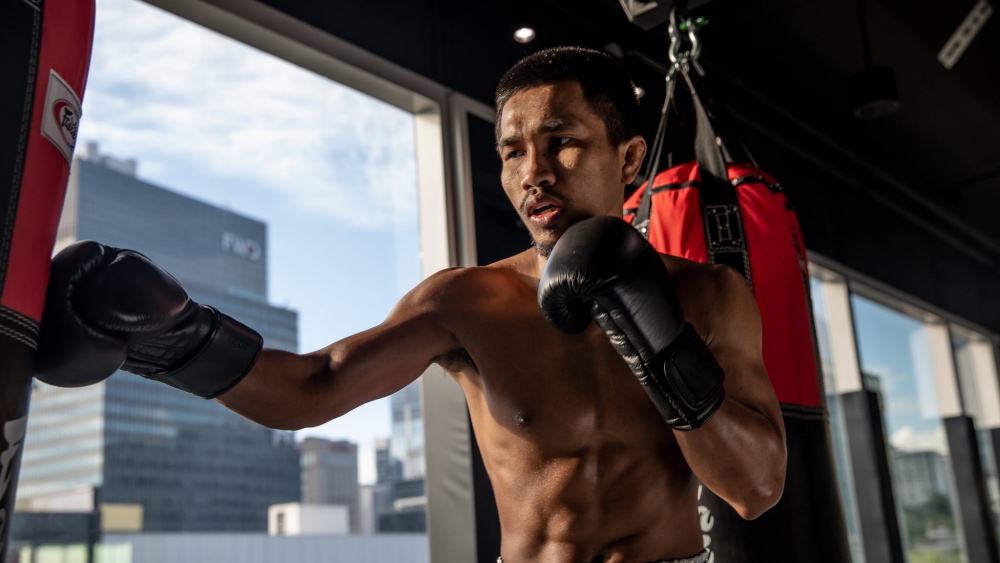
This is a great way to warm up your muscles and get your blood flowing. Start by throwing some light punches at a target, gradually increasing the intensity as you go. Make sure to keep your form in check, and don’t sacrifice power for speed.
An excellent way to build your conditioning for Muay Thai is by working for set periods like a minute. Throw as many punches as you can until your arms start to burn, and use that as a marker for your next session. Gradually increase the length of your conditioning drills to improve your conditioning.
2) Shadowboxing
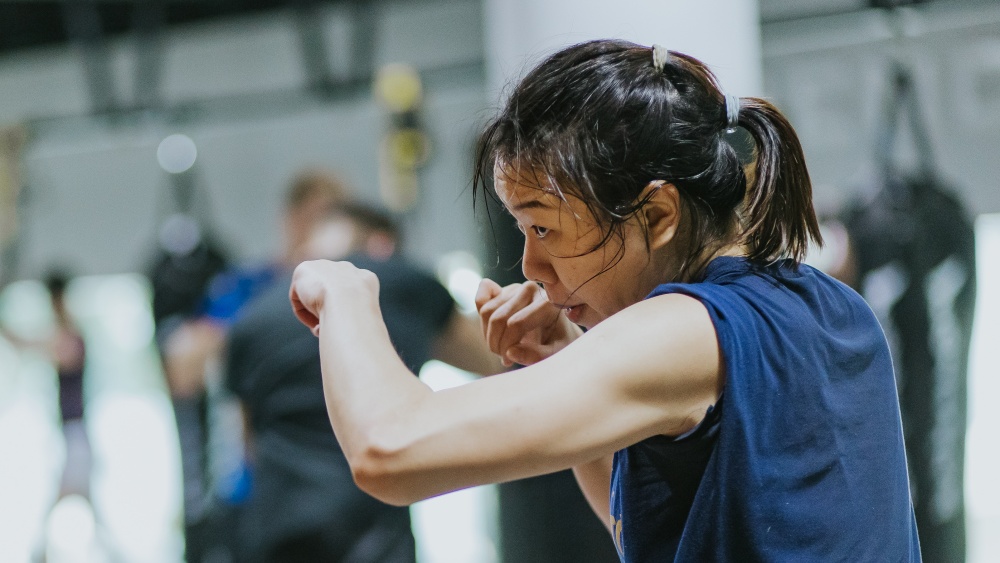
Shadowboxing is one of the best ways to improve your technique and conditioning. It helps you work on your form as it allows you to practice like you were fighting a real opponent.
The key to getting the most out of your shadowboxing is making it as realistic as possible. For example, if you have an upcoming fight that includes six three-minute rounds, shadow box for the same amount of time. Imagine you’re fighting your opponent and use your footwork, blocks, and head movement to evade their attacks while firing hard counters of your own. Shadowboxing is the next best thing to sparring when done correctly. It allows you to work every aspect of fighting besides actually getting hit.
3) Bag Work
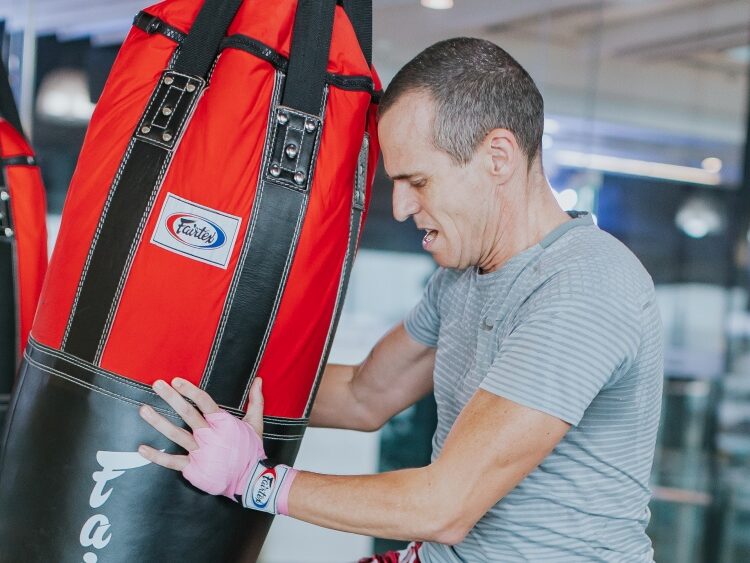
Working with a heavy bag helps to improve your endurance and power. Take things easy when working with a heavy bag. Start with light punches and kicks, then increase the intensity as your body loosens up. Start throwing strikes as hard as you can once you’re warmed up and start your drills.
There are countless drills you can perform with a heavy bag. As is the case with shadowboxing, the key to getting the most out of your sessions is training realistically. Don’t just stand there and throw strikes unless the drill you’re performing dictates such. Instead, move around the bag with your footwork and try to evade it when it swings back towards you. Work with the bag as if it was a real opponent in front of you.
To improve your conditioning for a particular technique, set a timer for one or two minutes and execute the technique as many times as you can during that window. That should give you a good burn – if it doesn’t, set the timer for a longer period.
4) Kicking Drills
Kicking drills are similar to punching drills. The goal is typically to perform as many kicks as you can in a set period. Executing your technique with proper form is key to getting the most out of these drills since it helps to build your muscle memory.
You can perform kicking drills with a heavy bag, kicking shield, or a partner holding pads. An example of a kicking drill that helps build up your endurance is the roundhouse drill. You simply set a timer and fire off as many roundhouse kicks as you can while the clock runs. Switch sides after your first round, so you’re also improving your conditioning on your weak side.
5) Roadwork

Running is an effective way to build your conditioning for Muay Thai. It helps strengthen your legs and build up their endurance, so you don’t get tired as you move around the ring. It also improves your aerobic endurance, improving your overall stamina.
Roadwork is one of the oldest conditioning exercises fighters from combat styles like Muay Thai and boxing have used for centuries. It does not cost you anything. You only need a nice pair of running shoes to make roadwork a part of your training routine. You will quickly notice an improvement in your endurance inside the ring when you make running an integral part of your workout routine.
Try to limit roadwork to no more than three times a week to limit the stress it places on your joints.
6) Swimming
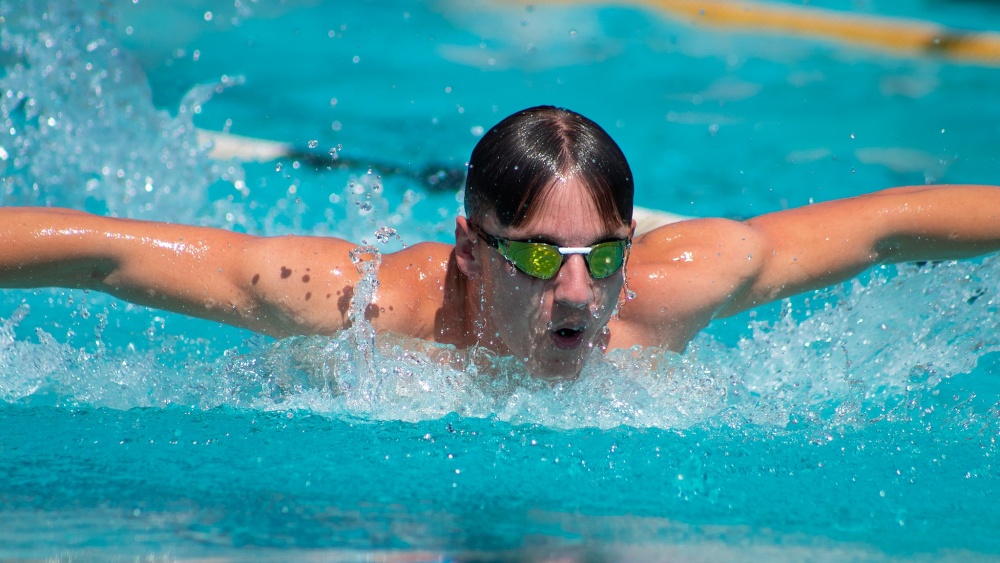
Swimming gives you a low-impact way to improve your endurance and conditioning. It’s gentle on your joints, yet it pushes your lungs to their limits as you make laps around a pool or swim in open water. Swimming gives you a full-body workout since it activates all the muscles in your body. It can also serve as an excellent cool-down after your workouts.
Frequently Asked Questions About Muay Thai Conditioning
Q: How Often Should I Do Conditioning Drills As Part Of My Muay Thai Training?
A: For most practitioners, conditioning work integrated into three to five training sessions per week is sufficient to see steady improvement. This does not mean five dedicated conditioning sessions — it means that each session should include at least one conditioning-focused element, whether that’s a round of punching drills, a kicking drill, or a run before class. The key is consistency over time. Sporadic intense sessions will not build the kind of endurance that holds up across a full fight or a long training camp.
Q: Should I Focus On Conditioning Or Technique First As A Beginner?
A: Both should be developed simultaneously from the start, because in Muay Thai they are not separate. Every time you drill a technique repeatedly, you are conditioning your body to perform that movement. The more you shadowbox, work the bag, and run, the fitter you get — and the fitter you get, the better your technique holds up under pressure. At Evolve MMA in Singapore, beginner classes are structured so that technique and conditioning are built together from the very first session, which is the most efficient approach for long-term development.
Q: How Do I Know When To Increase The Intensity Of My Conditioning Drills?
A: A simple benchmark: if you can complete your current drill without significant fatigue by the end of the set period, it is time to increase the duration or intensity. For example, if you can throw punches for one minute without your arms burning, extend the interval to 90 seconds. Progressive overload — gradually increasing the demand on your body — is the principle that drives conditioning improvement across all sports, and Muay Thai is no different. Never jump to maximum intensity too quickly, as this increases injury risk and can compromise your technique.
Q: Is Roadwork Really Necessary If I’m Already Doing Bag Work And Sparring?
A: Roadwork builds a different kind of fitness from bag work and sparring. Heavy bag sessions and sparring develop your anaerobic capacity, your ability to produce explosive efforts in short bursts. Running, particularly longer steady-state runs, builds your aerobic base, the underlying engine that determines how quickly you recover between those explosive bursts. Fighters who skip roadwork often find that their technique deteriorates quickly in later rounds, not because their technique is weak, but because their aerobic base cannot keep up with the demands of the fight. Both are necessary.
Q: Can I Do These Conditioning Drills At Home Without A Gym Or Heavy Bag?
A: Yes. Shadowboxing and roadwork require no equipment at all and cover a significant portion of the conditioning work most fighters need. Swimming is accessible to anyone with a pool nearby. If you do not have a heavy bag, you can still perform punching and kicking drills by shadow drilling — executing the technique in the air with full commitment and form. The absence of a bag removes the tactile feedback and resistance, but the cardiovascular and muscular conditioning benefits are still meaningful when the drills are performed with intention and proper technique.
Q: How Does Conditioning Affect Technique In A Real Fight Or Sparring Session?
A: Fatigue is the enemy of technique. When your conditioning begins to fail, your guard drops, your footwork slows, your hip rotation diminishes, and your reactions become sluggish — all of which make you both less effective offensively and more vulnerable defensively. Conditioning drills are essentially practice for keeping your technique intact under physical stress. The more consistently you train under fatigue, the longer your technique will hold up when it matters. This is why coaches often say that conditioning is not just physical preparation — it is technical protection.
Q: How Long Does It Take To Build A Solid Conditioning Base For Muay Thai?
A: For most people training consistently three to five times per week, meaningful improvements in conditioning are noticeable within four to six weeks. A solid base that allows you to train and spar at full intensity without significant fatigue typically takes three to six months of consistent work. This timeline varies depending on your starting fitness level, the quality of your training, and how well you manage recovery. The most important variable is consistency — showing up regularly over months and years is what builds the kind of conditioning that defines elite Muay Thai fighters.
Q: What Is The Best Single Conditioning Drill For Muay Thai If I Only Have Limited Time?
A: Shadowboxing is arguably the most versatile and accessible conditioning drill available. It requires no equipment, can be done anywhere, and — when performed with genuine intensity and realistic visualisation — delivers both cardiovascular conditioning and technical reinforcement simultaneously. If you have more time and access to a bag, combining three rounds of bag work with a 20-minute run covers both the anaerobic and aerobic demands of the sport efficiently. The best drill, however, is always the one you will actually do consistently.
Final Thoughts
Conditioning is not a phase of training you graduate from; it is a permanent commitment that separates fighters who improve from those who plateau. The six drills covered in this article are simple, proven, and accessible to practitioners at every level, but their value depends entirely on how consistently and honestly you apply them. Punching drills and kicking drills build the muscular endurance your weapons need. Shadowboxing and bag work keep your technique sharp under fatigue. Roadwork and swimming build the aerobic engine that makes everything else possible.
You may also like:
The Ultimate Guide To The Muay Thai Clinch
PakarPBN
A Private Blog Network (PBN) is a collection of websites that are controlled by a single individual or organization and used primarily to build backlinks to a “money site” in order to influence its ranking in search engines such as Google. The core idea behind a PBN is based on the importance of backlinks in Google’s ranking algorithm. Since Google views backlinks as signals of authority and trust, some website owners attempt to artificially create these signals through a controlled network of sites.
In a typical PBN setup, the owner acquires expired or aged domains that already have existing authority, backlinks, and history. These domains are rebuilt with new content and hosted separately, often using different IP addresses, hosting providers, themes, and ownership details to make them appear unrelated. Within the content published on these sites, links are strategically placed that point to the main website the owner wants to rank higher. By doing this, the owner attempts to pass link equity (also known as “link juice”) from the PBN sites to the target website.
The purpose of a PBN is to give the impression that the target website is naturally earning links from multiple independent sources. If done effectively, this can temporarily improve keyword rankings, increase organic visibility, and drive more traffic from search results.